



Ferrari Enzo: Antoine Dufilho uses carbon for the first time
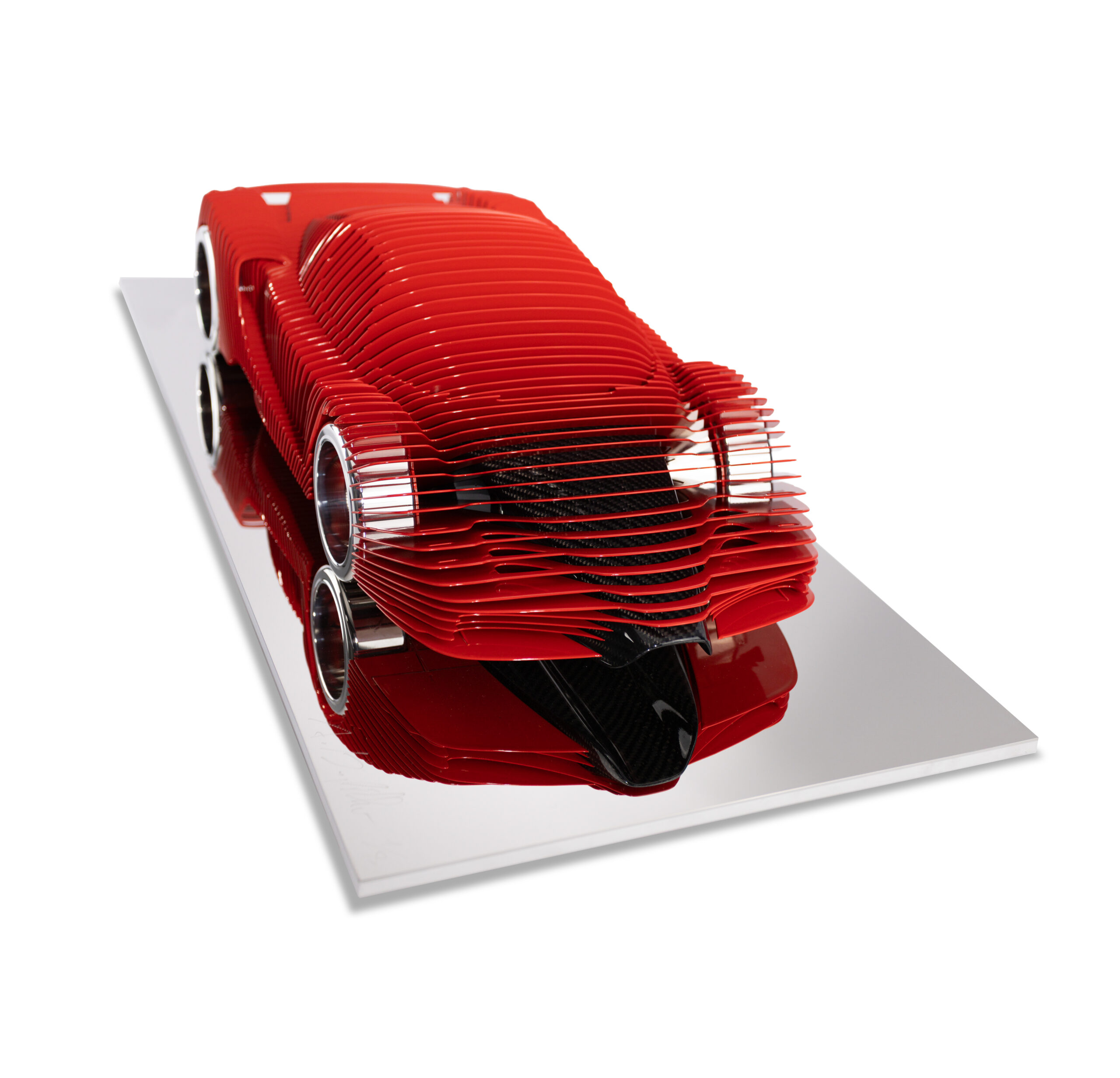
The Ferrari Enzo introduces a new dimension in Antoine Dufilho’s work. For the first time, the French sculptor uses carbon. This material, derived from motor racing, enters the workshop in the Lille countryside.
The Ferrari Enzo, a legendary supercar
The Ferrari Enzo holds a special place in the history of the Prancing Horse marque. Introduced in 2002, this supercar pays tribute to the Scuderia’s founder, Enzo Ferrari, who died in 1988. Produced until 2004 in an edition of around 400, it represents the very best that Maranello knew how to make at the turn of the millennium.
Its 6-liter V12 engine develops 660 horsepower. At the time, the Enzo concentrated technologies derived from Formula 1 racing. Its lines, designed by Ken Okuyama for Pininfarina, contrasted with the sensual curves of previous Ferraris. Angular shapes, prominent air intakes, aggressive aerodynamics: everything is designed for performance.
This model was the logical choice to inaugurate Antoine Dufilho’s use of carbon. The original Enzo itself uses this material in its structure and bodywork. In this way, the artist maintains consistency between the model and its interpretation.
Carbon enters the Dufilho workshop
A material that speaks to enthusiasts
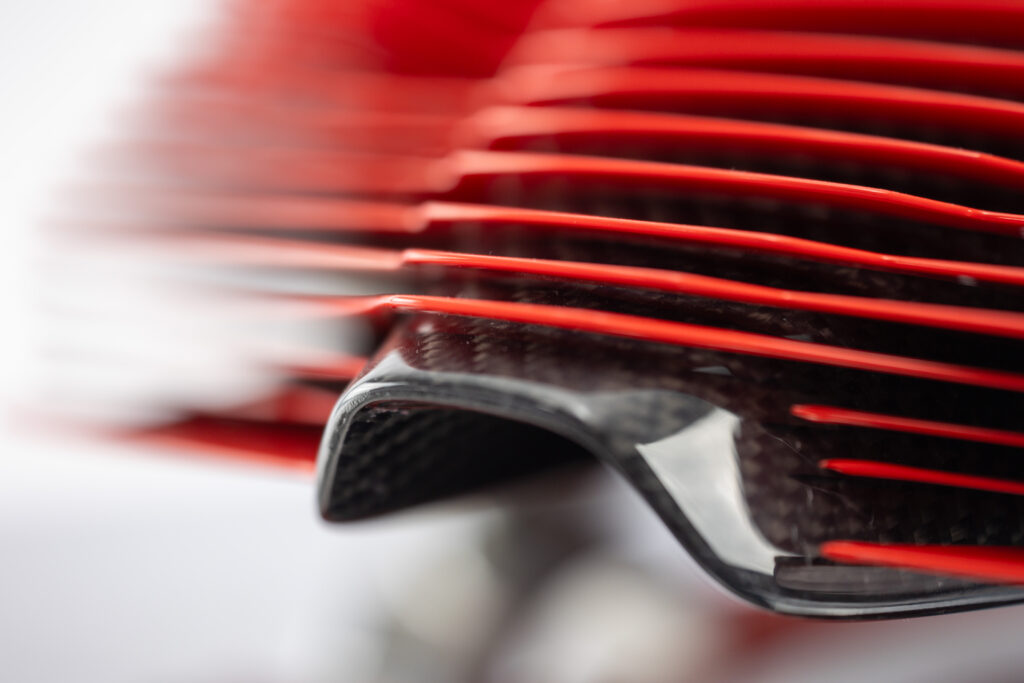
Carbon has a long history in motor racing. Used in Formula 1 since the 1980s, it embodies the quest for lightness and performance. Its woven texture, instantly recognizable, is a reminder of high-level motor racing.
With this material, Antoine Dufilho broadens his technical palette. Aluminum, mirror-polished stainless steel, corten steel, ebony: over the years, the artist has explored a variety of materials. Carbon completes the picture.
The dialogue between materials
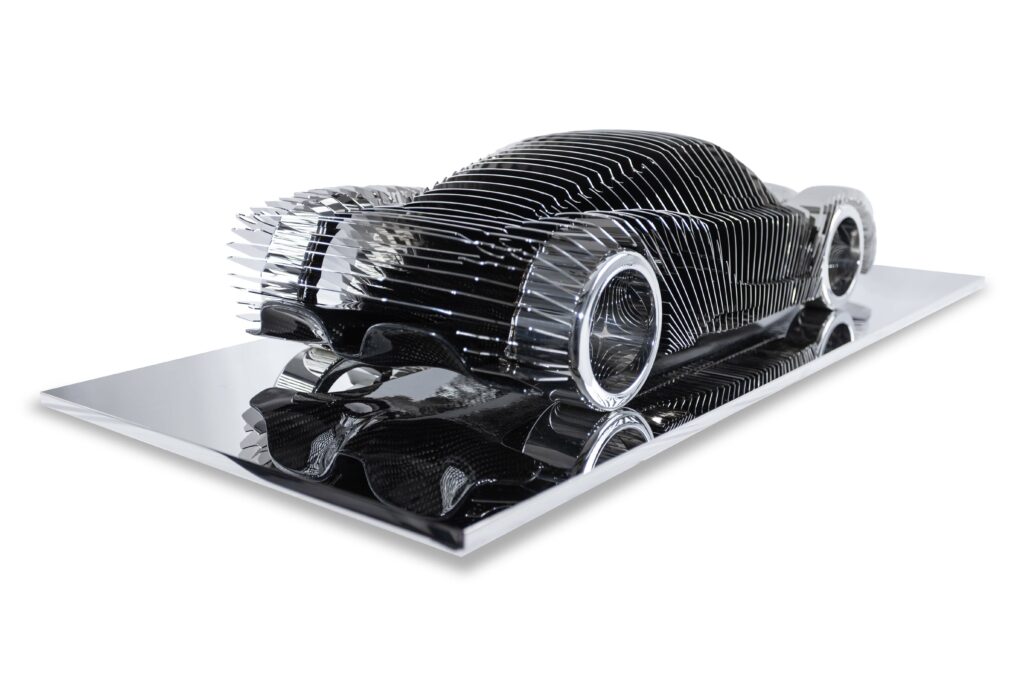
On the Ferrari Enzo sculpture, carbon rubs shoulders with mirror-polished stainless steel. The contrast is effective: on one side, the matt, woven texture of carbon, on the other, the gleaming reflections of stainless steel. The carbon elements, placed on the lower parts of the sculpture, are directly reminiscent of supercars.
This mix of materials is nothing new for Antoine Dufilho. As far back as 2013, with his Mercedes Streamliner, he combined ebony and mirror-polished stainless steel. The combination of carbon and stainless steel continues this research. All the models in the collection show this evolution in the choice of materials.
Dufilho technique at the service of the Enzo
The disappearing effect
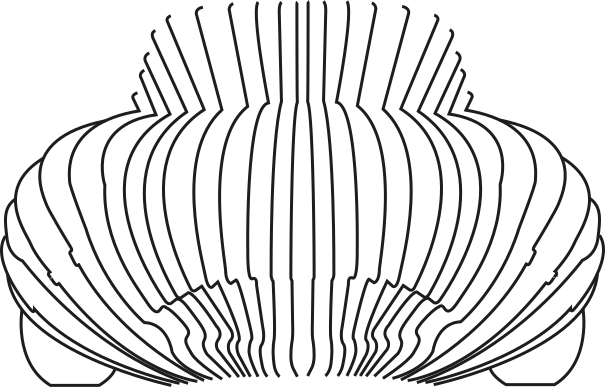
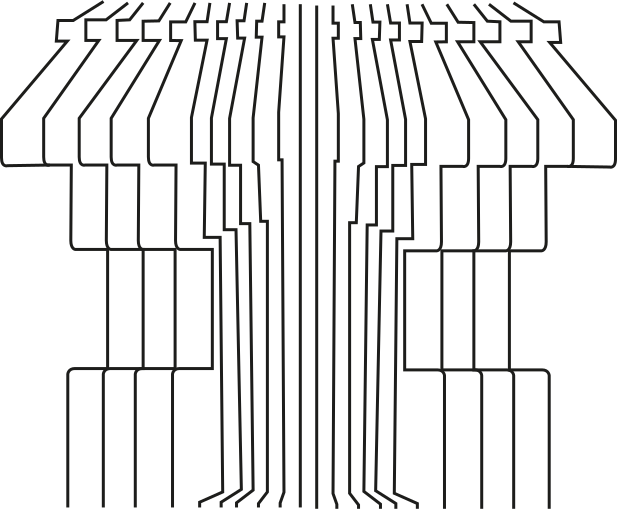
The Ferrari Enzo sculpture uses the Streamline technique developed by Antoine Dufilho. The principle: a transverse cut of the subject in successive plates. The result: the sculpture appears to disappear when viewed from the side, then reappears when viewed from the side. The lines of the Enzo, designed to exceed 350 km/h, lend themselves well to this approach.
The mirror-polished stainless steel base enhances the effect. The reflection splits the sculpture in two, accentuating the impression of lightness. This reflective base recurs on many of the artist’s pieces.
Two versions, two atmospheres
The Ferrari Enzo is available in two versions. The first, dark, plays on the reflections between the plates. Light glides over the surfaces and hollows out the volumes. This version highlights the sculpture’s structure and lines.
The second, red, takes up Ferrari’s historic color. The red lacquer contrasts with the apparent carbon. The blend is directly reminiscent of Maranello’s supercars.
On both versions, polished stainless steel circular wheels frame the sculpture. Their simple shape contrasts with the complexity of the fuselage plates.
Continuous evolution
The arrival of carbon in Antoine Dufilho’s work is part of a process of exploration. Since 2011 and his first Bugatti Type 35 in solid aluminum, the sculptor has been testing new techniques and materials.
A graduate of the École d’Architecture et de Paysage de Lille, Antoine Dufilho built his studio in the Lille countryside from shipping containers. Here, he develops his techniques, from welding to molding. This self-taught approach gives him total freedom for each project. Collectors interested in a made-to-measure piece can consult the commissioned projects.
Represented in over 60 galleries in France and abroad, Antoine Dufilho continues his research. The Ferrari Enzo with carbon could herald other creations using this material.
To keep up with the latest news from the workshop, visit our Instagram account.