



Why Antoine Dufilho rejects overproduction
The temptation to multiply works to increase visibility exists for all artists. Faced with sustained demand and numerous distribution opportunities, some give in to the temptation. Antoine Dufilho has made a different choice. Since 2012, the year he devoted himself fully to sculpture, the French sculptor has maintained a measured pace of creation. This refusal to overproduce is not an imposed constraint. It’s a discipline that contributes to the quality of his work, its coherence and the trust that collectors place in him.
Overproduction: a known risk in contemporary art
When the purpose is diluted
Artists who multiply their creations at a steady pace risk exhausting their visual vocabulary. Variations become repetitions. What was once a recognizable signature becomes a formula. The public, gallerists and collectors alike perceive this fatigue. A work that would have made its mark in a smaller body of work goes unnoticed in the midst of a plethoric output.
Visibility and value: two distinct notions
Multiplying pieces can create an illusion. More works means more gallery presence, more publications, more transactions. But increased visibility is no guarantee of lasting recognition. It can produce the opposite effect: a saturation that dulls interest and trivializes the work. The value of a work is also determined by what an artist chooses not to do.
The weary look
Discerning collectors know the difference between a genuine evolution and an opportunistic variation. Faced with an overloaded catalog, their eyes grow weary. Works become confused, losing their singularity. Overproduction ends up doing the artist a disservice.
Antoine Dufilho: volume is not a priority
An inherently slow creative process
Antoine Dufilho sees each sculpture as a stage in his journey, not as a product to be reproduced. His process involves an extended design period. Drawing precedes realization. Every detail is thought through before being executed. A graduate of the École d’Architecture et de Paysage de Lille, he has developed a rigorous approach to structure and framework, an atypical background that is recounted in his biography.
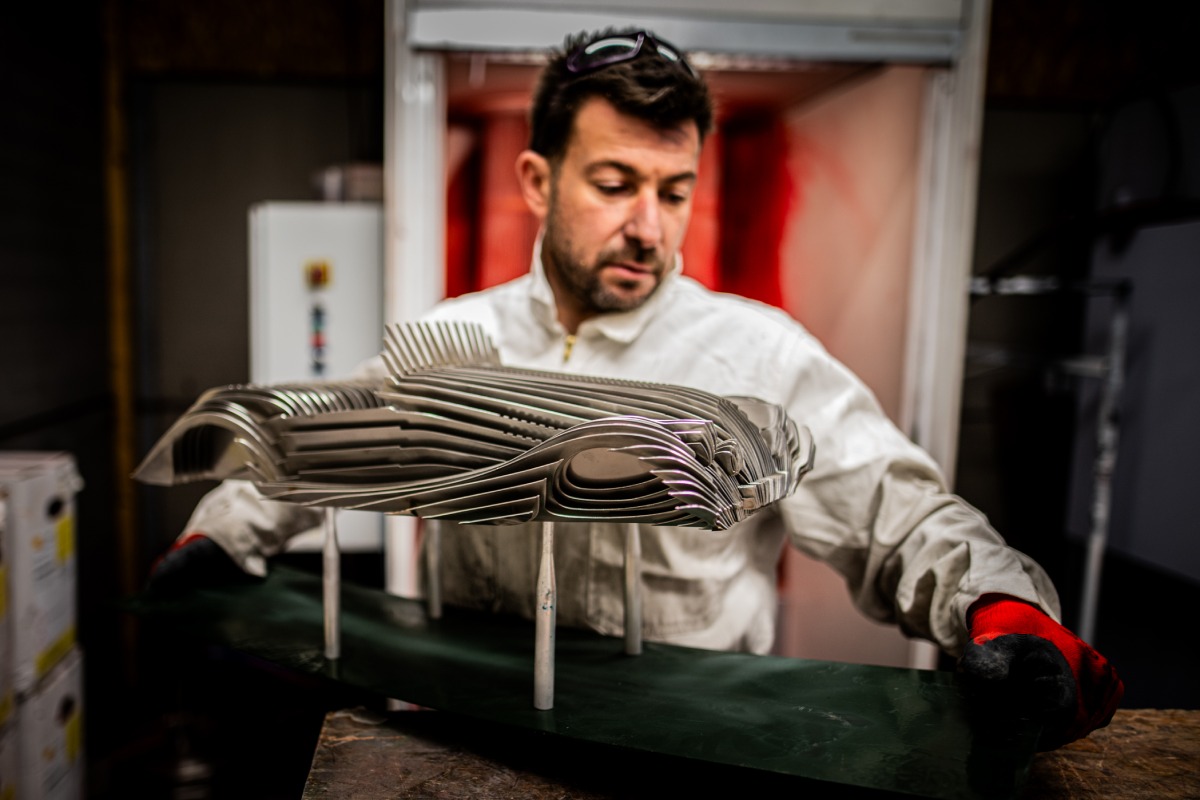
In his workshop in the Lille countryside, built with his own hands from shipping containers, the sculptor experiments with molding and welding. This artisanal dimension imposes a rhythm incompatible with mass production. The materials used (stainless steel, aluminum, corten steel, precious woods) demand specific know-how and incompressible working time.
No mechanical repetition
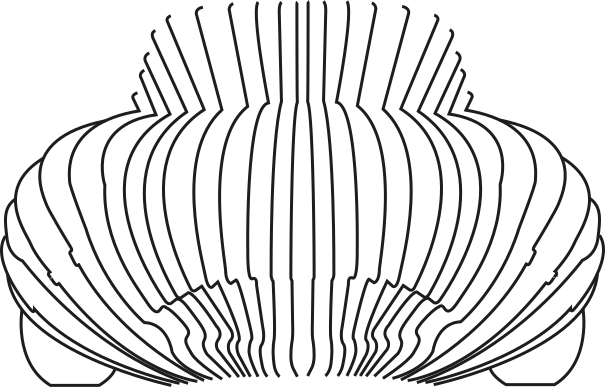
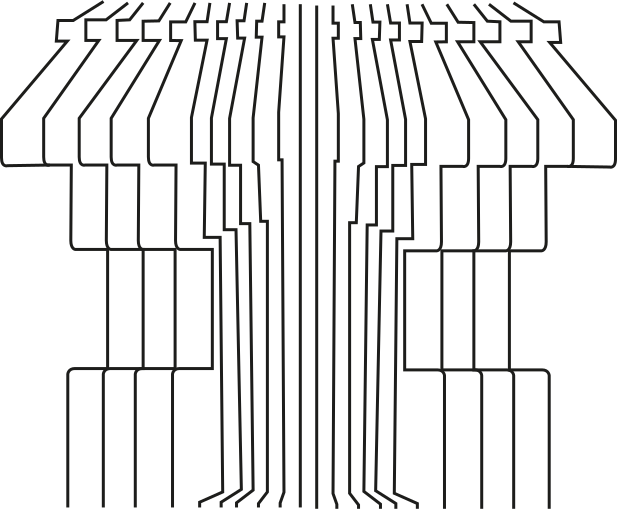
Antoine Dufilho could have capitalized on his most recognizable techniques, declining them ad infinitum. He chose a different path. When he developed his Streamline technique in 2022, characterized by a longitudinal cut that makes the sculpture disappear when viewed from the front, he didn’t systematically apply it to all his models. He adapted it, questioned it and developed it further. The more recent Solaire technique illustrates this constant research.
Each new sculpture adds something to the existing body of work. It does not duplicate previous works. This requirement explains why some models remain unique, why some series remain limited.
Produce less to stay legible
A recognizable signature
Antoine Dufilho’s work is immediately recognizable. The alternation of solids and voids, the play with light and reflections, the search for transparency and lightness. These elements form a coherent sculptural language. This legibility does not come from the multiplication of pieces, but from the deepening of a formal vocabulary over time.
Since his first automotive sculptures in 2011, the sculptor has evolved his style without betraying it. From the full-aluminum Bugatti Type 35 of his early days, to the Mercedes Streamliner combining ebony and mirror-polished stainless steel, to monumental sculptures such as the Red Racing Flower and Gunmetal Symphony: each work is part of a continuity, while bringing its own share of novelty.
No opportunistic variations
An artist faced with demand may be tempted to produce multiple versions of his successes, in a variety of formats and colors. Antoine Dufilho resists this logic. His series remain coherent. His variations are motivated by artistic intent, not commercial opportunity. When he proposes several interpretations of the same automobile model, such as the Ferrari 250 GTO, each one explores a different technique: Streamline, wall hanging, tricolor treatment. These are not repetitions, but distinct takes on the same subject.
A reassuring rarity
An unsaturated market
Antoine Dufilho’s production discipline generates a rarity that is not artificial. Works are not rare because they are withdrawn from the market or voluntarily stored. They are rare because the artist creates few of them, because each one takes time, because quality takes precedence over quantity.
For collectors, this natural rarity is reassuring. The works acquired do not risk being drowned in a stream of similar productions. They retain their singularity.
Expected works
Represented in over forty galleries around the world, Antoine Dufilho could meet any demand by increasing his pace. He maintains his high standards. New pieces are eagerly awaited by gallery owners and collectors precisely because they are not systematic. Each presentation at a show like Rétromobile or Art Up is an event, not because it’s an announcement, but because the works presented are the result of several months’ work.
A long time coming
Collectors who are interested in Antoine Dufilho’s work are not looking for a passing fad. A limited, coherent body of work is easier to read, study and pass on than a scattered accumulation. This is what appeals to an international clientele that is committed to the durability of the works it acquires.
Overproduction is not inevitable. It’s the result of a choice, often dictated by imperatives outside the creative process. Antoine Dufilho proves that there is another way. Produce less to create better. Resisting the temptation of volume to preserve the intensity of each piece. For a sculptor who transforms metal into evocations of movement and speed, this may well be the only approach that lasts.
Photo credit: Ph.Eric Ceccarini