



Antoine Dufilho: copied but never equalled
Antoine Dufilho’s work is being emulated. On the automotive sculpture market, works based on his codes are appearing regularly. Cut-out shapes, plays on transparency, revisited mythical automobiles: the visual recipes are spreading. But a copy is still a copy. Here’s what sets the original apart.
An unrivalled career path
Antoine Dufilho didn’t learn sculpture at art school. His path led first to medicine, then to architecture. For three years, he studied human anatomy. He learned how an internal structure supports an external form, how a skeleton gives a body its hold. This approach is reflected in his sculptures: the skeleton comes first, the bodywork afterwards.
Frustrated by a curriculum that limited his creativity, he switched to the Lille School of Architecture and Landscape Design. There, he learned to think in volumes, to play with fullness and emptiness, to inscribe a form in a space. His sculptures bear this imprint: they interact with their environment, change according to the angle of view, breathe.
There’s also a family history. Antoine’s great-uncle Jacques was a Bugatti collector. This passion has been passed on. In 2011, when Antoine created his first sculpture, he chose a Bugatti Type 37. It belonged to the family garage. This emotional bond with the automobile can’t be invented. It gives his works a sincerity that copies can’t replicate.
In-house techniques
Antoine Dufilho invents his own methods. He gives them names, evolving them over the years. This vocabulary belongs to him.
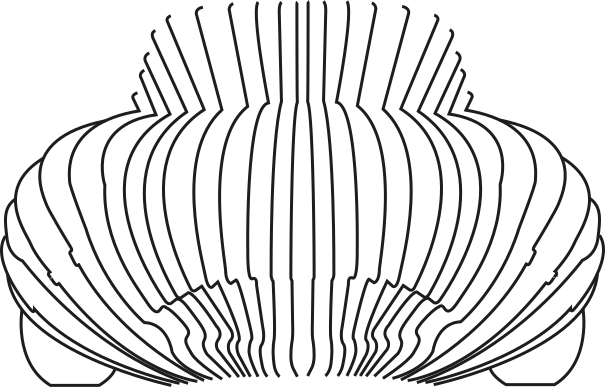
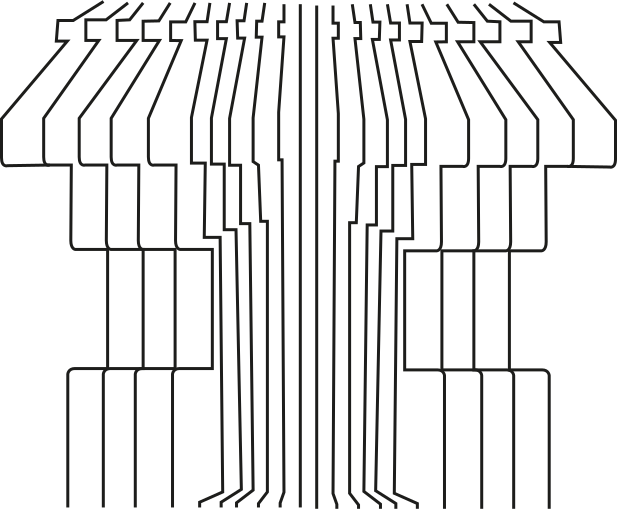
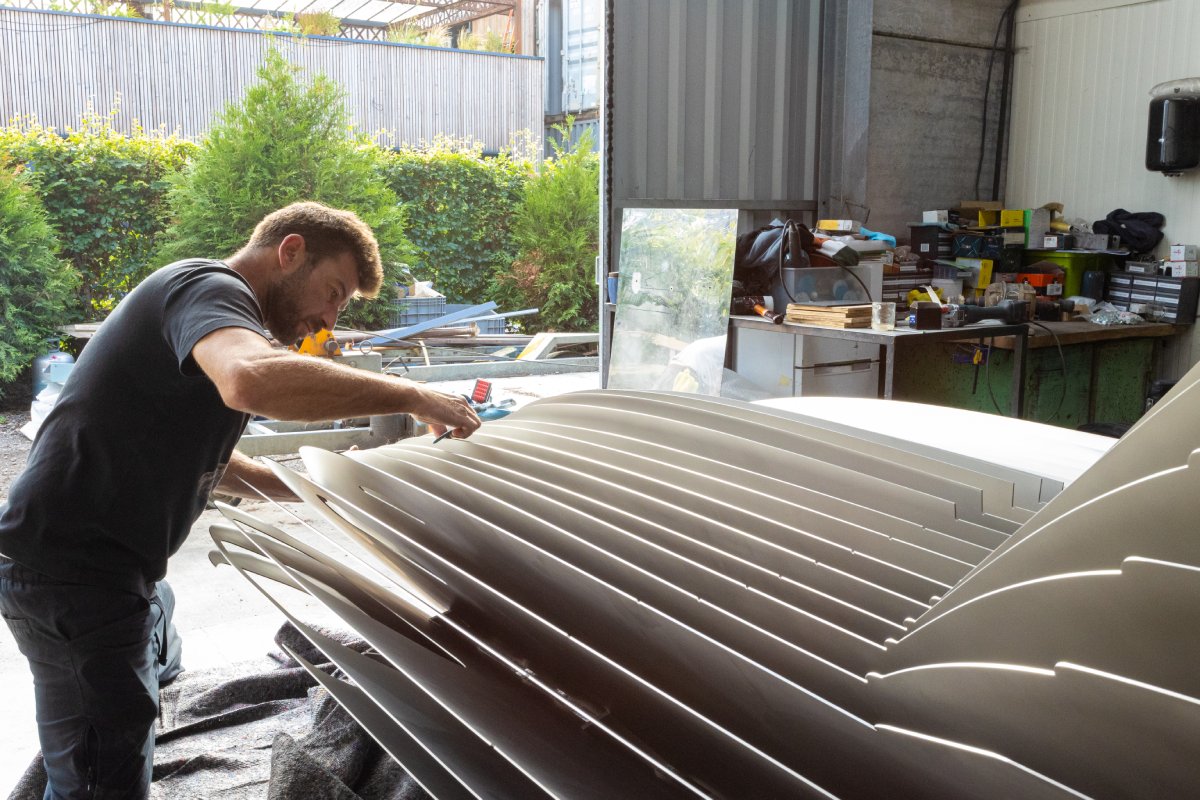
In 2022, he developed a longitudinal cutter that he named Streamline. Metal blades aligned lengthwise. Facing the sculpture, you see almost nothing. The thin edges of the plates let the eye pass through. All you have to do is step back to see the car appear. The idea comes from the wind tunnel: to show the air that envelops a body, the invisible flow that engineers study. The Ferrari 250 GTO Red Stream is the best-known example. It was seen by 400,000 people at the Mondial de l’Auto 2022.
With the Porsche 993, he launched the Solaire technique. Two sets of plates arranged in a spoke pattern interlock without ever touching. The effect is reminiscent of two cooperating gears. A nod to the precision engineering so dear to Porsche.
Starting in 2017, the Asymmetrical Porsche 356 explores another avenue. The plates are not evenly distributed. This imbalance disturbs the eye. Our brain, accustomed to anticipating, projects movement. The sculpture seems on the verge of tipping over, of accelerating. Immobile, it gives an impression of speed.
Other works use stainless steel tubes rather than plates. Viewed from the front, they form a honeycomb. The car disappears. Seen from the side, it reappears. The Porsche 930, the Shelby Cobra and the Mercedes 300 SL follow this treatment.
The Porsche 910 Chameleon takes the optical game even further. Each plate is painted blue on one side, yellow on the other. Depending on the angle, the sculpture appears entirely blue, entirely yellow, or green through a mixture of reflections.
Collaborations you can’t make up your own
Copying a shape is one thing. Copying partnerships with Jean Todt or Jean-Éric Vergne is another matter.
For the Peugeot 205 T16, Antoine Dufilho worked with the man who designed the original car. Jean Todt, then head of Peugeot Sport, had supported the T16 project in the 80s. He participated in the design of the sculpture, gave his opinion and validated the choices made. The result: for the first time, a series of Dufilho sculptures bears two signatures. That of the artist and that of Jean Todt.
The DS E-Tense Formula E sculpture is the result of a collaboration with two-time Formula E world champion Jean-Éric Vergne. The work celebrates both performance and DS’s commitment to electric mobility.
Antoine Dufilho is also represented by over 60 galleries worldwide. This network has been built up over years of work, exhibitions and patiently woven relationships. An imitator can reproduce a silhouette. He cannot invent this network.
Works in public spaces
Antoine Dufilho’s sculptures don’t remain hidden away in private collections. Some occupy public squares, approved by local authorities.
In front of the Westminster Hotel, in Le Touquet, sits a Ferrari 330 P4, 4.60 m long. 100 red-lacquered aluminum slats make up this Red Racing Flower. It weighs 1.7 tons. Before settling there permanently, it had been exhibited at La Baule.
Riva La Dolce Vita, the artist’s first monumental boat sculpture, was first presented in Sainte-Maxime during the summer of 2024. Since December 2024, it has been installed in Le Touquet. Rusted Corten steel replaces the wood of the original Aquarama.
Antoine Dufilho’s work has also been shown at the Grand Prix de France 2022, at the Mondial de l’Auto in the same year, at the Rétromobile 2023 show, and at Lille Art Up! on several occasions. These events have left their mark in the form of catalogs, press articles and photos. A documented career that no one can counterfeit.
How to recognize a true Dufilho
For collectors, there are a few points to bear in mind in view of the growing number of copies.
An authentic work comes with a certificate signed by the artist. Purchases are made either directly from the studio, or through a gallery in the network. If in doubt, simply contact the studio to verify.
The devil is also in the finishing touches. On a Dufilho, the welds are invisible, the bead blasting regular, the mirror polish deep. Copies can often be spotted at this level. And if the price seems too good to be true, there’s a problem. A Dufilho sculpture represents weeks of work and quality materials.
Copying, an involuntary tribute
The proliferation of imitations says something. It says that Antoine Dufilho has created a visual language strong enough to inspire others. It says that he has defined codes in automotive sculpture, a field in which he is now a benchmark.
For the discerning connoisseur, the choice is simple. On the one hand, works signed by the man who invented this vocabulary, rooted in a personal history and validated by prestigious collaborations. On the other, copies that only look the part.
The resemblance stops at the surface.