



Antoine Dufilho: when the sculptor takes to the open seas
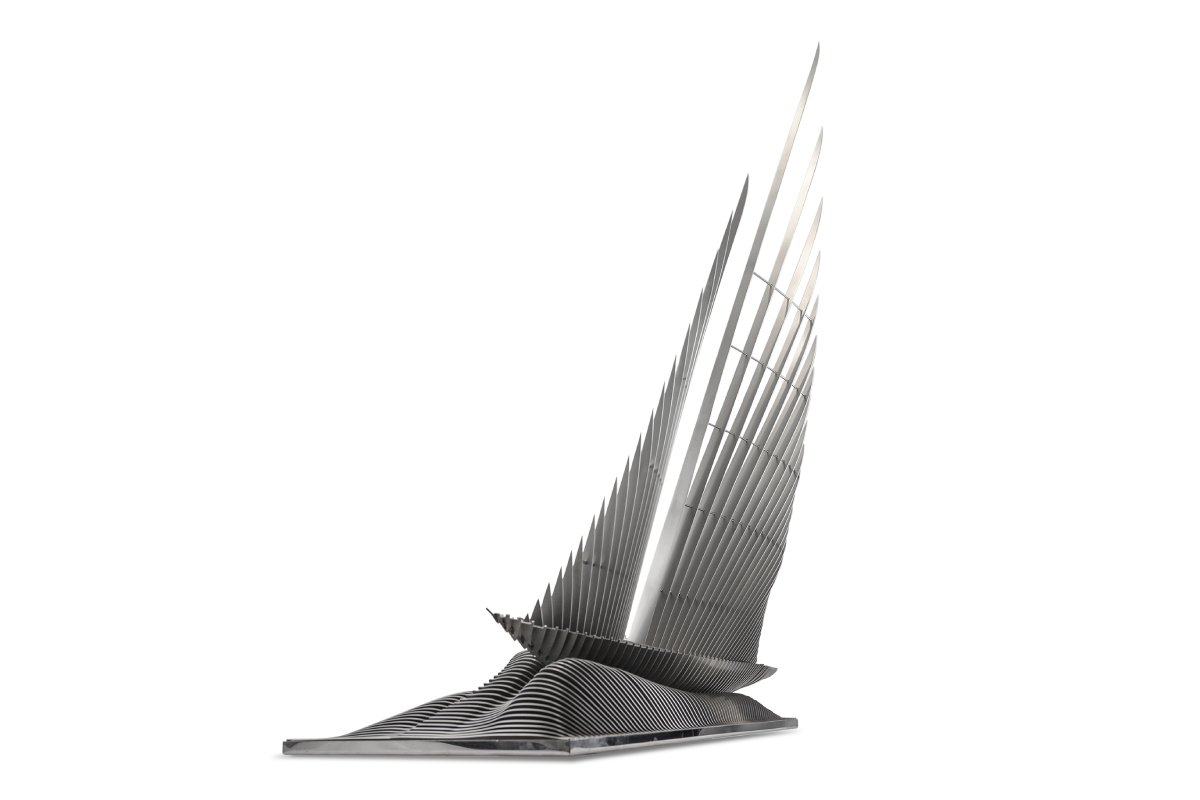
Known for his automotive sculptures that capture movement in metal, Antoine Dufilho has been expanding his artistic territory in recent years. After Ferraris, Porsches and Bugattis, the French sculptor is now tackling legends of the sea. From the Riva Aquarama to the J-Class and the Arno XI hydroplane, boats are playing an increasingly important role in his work. An evolution that is by no means accidental.
Riva Aquarama: first foray into the sea
The story begins in 2021. That year, Antoine Dufilho created his first sculpture inspired by the Riva Aquarama, the Italian runabout that had become an icon of nautical luxury since the 1960s. For this first interpretation, the artist combines precious wood and metal, two materials that interact to evoke the elegance of the Lombardy brand’s motorboats.
The choice of Riva is not insignificant. Like the Bugattis and Ferraris that populate its workshop, the Aquarama embodies a certain golden age of design. Taut lines, noble materials, attention to detail: the codes are the same, whether for driving or sailing. For Antoine Dufilho, moving from the road to the sea ultimately means pursuing the same quest: translating movement and speed into a static form.
A second version of the Riva saw the light of day shortly afterwards. The artist refined his approach, experimenting with the contrasts between wood species and the reflections of polished metal. These first small-scale pieces laid the foundations for a body of work that was soon to change scale.
La Dolce Vita: a monumental view of the sea
In 2024, Antoine Dufilho reached a milestone. He presented
For this piece, the artist chose to work in Corten steel, whose rusty patina naturally evokes the mahogany of Riva hulls. The base and structural elements are made of mirror-polished stainless steel, creating a striking contrast between mattness and brilliance. The 6-centimeter-thick slats that make up the fuselage create the alternating solids and voids characteristic of the Dufilho style.
The back of the sculpture deserves particular attention. The blades stretching backwards suggest the wake left by the boat on the surface of the water. A kinetic effect reinforced by the undulating base that mimics the waves.
La Dolce Vita was first exhibited in Sainte-Maxime during the summer of 2024, facing the Mediterranean. Since November 2024, it has been enthroned on the Promenade des Princes de Monaco in Le Touquet-Paris-Plage, where it dialogues with the North Sea. The town is also planning a water and light show to enhance the work’s night-time scenography.
This permanent installation marks an important milestone. After the Red Racing Flower (Ferrari 330 P4) installed in front of the Westminster Hotel, Le Touquet is now home to two monumental sculptures by the artist. The seaside resort thus becomes a veritable open-air gallery for his work.
The Ferrari Arno XI: a tribute to a speed record
Antoine Dufilho’s nautical creations also include the Ferrari Arno XI, built in 2022. This Italian hydroplane, powered by a Ferrari V12 engine, set a world water speed record of 241.7 km/h in 1953. A legendary machine that bridges the automotive and nautical worlds, it was an obvious choice for the sculptor.
For this piece, Antoine Dufilho combines rosewood with stainless steel. The precious wood recalls the hulls of the racing canoes of the time, while the stainless steel brings the reflections and modernity characteristic of the artist’s work. The sculpture, produced in an edition of 12, is presented by the artist’s galleries in Miami and Dallas.
The J-Class: heading for the world of sailing
After runabouts and hydroplanes, Antoine Dufilho now ventures into the world of sailing with the J-Class. These large racing yachts, built between 1930 and 1937, made their mark on the history of the America’s Cup. With their nearly 40-meter hulls, vertiginous masts and impressive sails, J-Class yachts embody the golden age of transatlantic racing.
Only ten J-Class were built at the time. Three have survived: Shamrock V, Endeavour and Velsheda, all designed by Charles Ernest Nicholson. Since the 2000s, several replicas have been built, reviving the regattas of these giants of the seas.
For Antoine Dufilho, the J-Class represents a new sculptural challenge. The verticality of the mast and sail, the tension of the shrouds, the slenderness of the hull: all these elements call for a specific treatment. This exceptional piece will appeal to collectors who are as passionate about the history of sailing as they are about contemporary art.
Towards new horizons
Antoine Dufilho’s nautical adventure is just beginning. The artist is currently working on several projects that should see the light of day shortly: a speed catamaran inspired by the Wally, but also a new Riva. These works, still in the design phase, promise to explore new forms and new relationships to movement.
The catamaran, in particular, opens up interesting prospects. The double hull and stretched sails offer a radically different geometry to single-seaters or runabouts. We can imagine the artist applying his fan-shaped blade technique to suggest the tension of the wind in the sails.
By extending his repertoire to the maritime world, Antoine Dufilho remains true to his initial approach: capturing the essence of movement in metal. Whether the subject is rolling, flying or sailing, the quest remains the same. And collectors who have followed his work since the first Bugatti Type 35s can now build up a fleet alongside their stable.
To discover all of Antoine Dufilho’s boat sculptures, or to follow his forthcoming exhibitions, visit one of the 60 galleries representing him worldwide, or consult the artist’s news.