



A monumental Formula 1 designed by Antoine Dufilho for the Monaco Grand Prix 2026
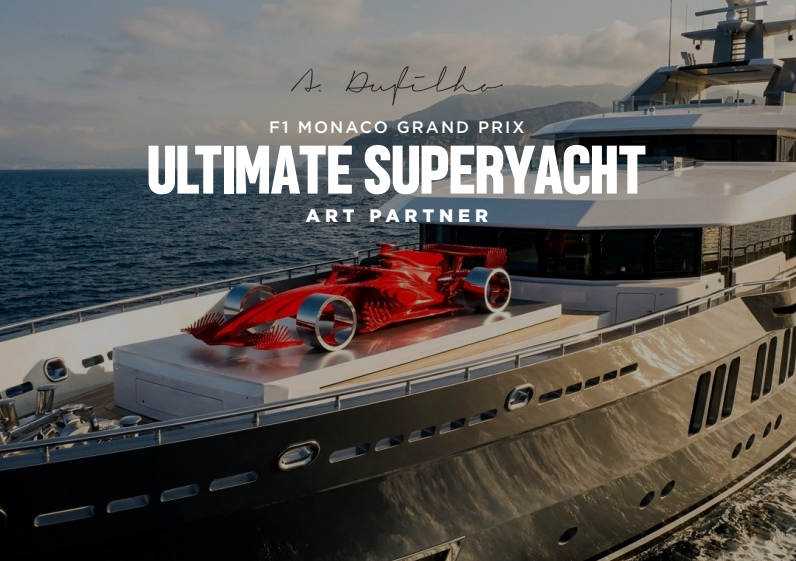
Formula 1 is undoubtedly the mechanical discipline most charged with imagination. By dedicating a monumental sculpture to it, Antoine Dufilho continues an approach begun over ten years ago: transforming speed into matter, and the automobile into emotion. Presented on a yacht during the Monaco Grand Prix 2026, the work offers an opportunity to look back on a singular body of work, where kinetic sculpture meets racing mechanics.
Formula 1, a myth born on the streets of Monaco
Few races can compare with the Monaco Grand Prix. First held in 1929 and run through the narrow streets of the Principality, it has forged part of the legend of Formula 1 racing. The layout, which has remained essentially unchanged for decades, is unlike any other: no clearances, no room for error, a ribbon of asphalt that hugs the city, its hills, tunnels and harbor. Drivers speak of it as a special test, where victory takes on a singular value.
This setting has nourished the collective imagination far beyond the circle of enthusiasts. Monaco is motor racing turned spectacle, memory and prestige. It’s this territory of images, of tension and elegance, which makes single-seaters so fascinating to represent, and which gives meaning to the idea of presenting a work of art dedicated to Formula 1.
Because Formula 1 is not just a racing car. It’s an instantly recognizable silhouette, an object of extreme design in which every surface responds to an aerodynamic requirement. There’s nothing decorative about it: form is entirely dictated by function, and it’s precisely from this tension that its beauty is born. This ambiguity, between performance tool and almost sculptural object, is at the heart of the artist’s interest.
Sculpting speed: Antoine Dufilho’s approach
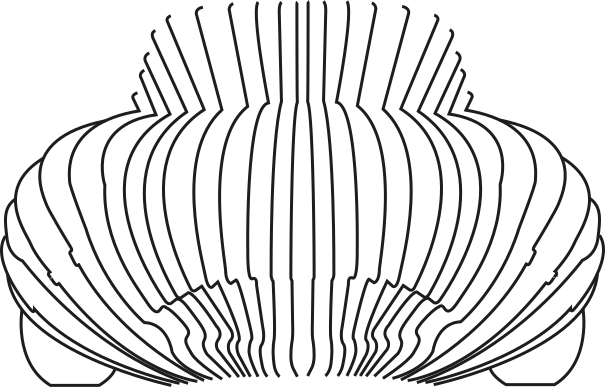
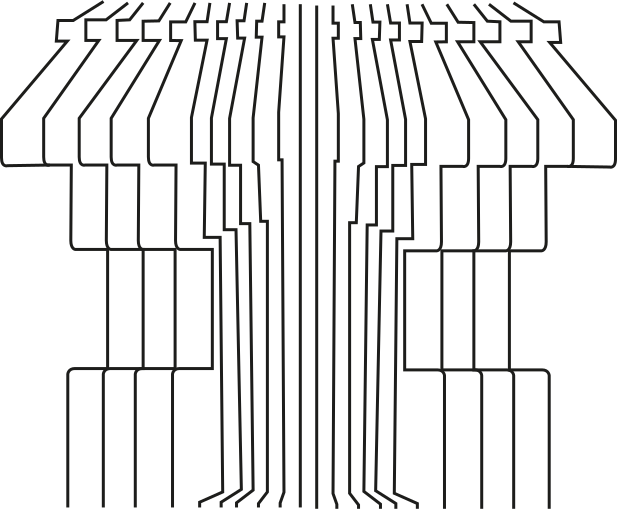
Since 2012, Antoine Dufilho has devoted his work to the meeting of kinetic art and mechanics. Trained in architecture, the artist has built up a language that is instantly recognizable: he breaks down the bodywork into a succession of strata, thin parallel strips separated by a void. This research into movement created from the immobile is the signature of his work. Sculpture is never quite full or quite hollow: it exists in this in-between, where material becomes lace and air becomes an integral part of form.
The result isn’t revealed at a glance: it’s revealed as the viewer moves. Seen from the front, the subject recedes, almost transparent; seen from three-quarters up, it gathers, densifies and takes on body. A perfectly motionless car seems to take off. This is the paradox of this work: to freeze speed in metal, and yet to restore its sensation.
The artist’s research began with the most iconic bodies in automotive history. Applied to Formula 1, it finds a natural home: no other car so suggests movement at a standstill. It’s not the first time the artist has tackled this subject. In 2022, he signed Formula One, a sculptural tribute to the golden age of Formula 1: a monumental 1.2-ton piece unveiled at the French Grand Prix on the Paul Ricard circuit, in memory of the single-seaters of the 90s.
From gallery model to monumental work
Antoine Dufilho’s work unfolds on two scales. There are collector’s pieces, designed for the intimate space of the collector, and monumental works, which take sculpture out of the living room to inscribe it in a place, a landscape, an event. This alternation between monumental formats and intimate pieces structures his entire approach, and each format responds to a different intention.
Bringing a Formula 1 to life-size changes the very nature of the work. The sculpture is no longer an object to be contemplated from above: it measures up to the viewer, occupying space, imposing its physical presence. The artist’s monumental sculptures can reach spectacular dimensions – up to seven meters long and weighing over five tons for the largest – and require considerable studio work.
Each stratum has to be drawn, cut and assembled with rigorous precision, because the slightest approximation would show through on the whole. Understanding the materials and fabrication of a Dufilho sculpture, from mirror-polished stainless steel to corten, enables us to gauge the know-how that the artist has patiently built up, initially on his own, experimenting with metal, cutting and welding.
Art meets motorsport
Antoine Dufilho’s dedication to Formula 1 continues a long tradition of dialogue between art and the automobile. The racing car has inspired painters, photographers and designers, fascinated by its lines and what it says about an era. Kinetic sculpture adds an extra dimension to this tradition: it doesn’t just represent speed, it seeks to make it felt.
Presenting this piece as part of a Grand Prix, rather than in a gallery, is a logical choice. The work is directly confronted with its subject, as close as possible to the world that inspired it. It appeals to a broad public, one that doesn’t necessarily frequent exhibition venues, and creates an unexpected meeting point between the racing enthusiast and the art lover.
A work in keeping with the artist’s nautical universe
The choice of a yacht as an exhibition venue is no accident. In recent years, Antoine Dufilho has expanded his artistic territory beyond automobiles: the sculptor has taken to the open seas, tackling legends of the sea, from the Riva Aquarama to the J-Class and the Arno XI hydroplane. Presenting a Formula 1 on a ship brings together his two worlds, land and sea, racing and yachting.
Installed on the bow of a superyacht moored in the Principality’s harbour, the work will be seen from the quayside as well as from the sea, in the very setting that has shaped the myth of the race. The installation on the water, visible from all angles, makes the piece a landmark at the heart of the event.
A presentation for a busy 2026
The presentation of a monumental Formula 1 in Monaco is part of a particularly busy calendar for the artist. Between contemporary art fairs, temporary exhibitions and permanent installations in several European countries, Antoine Dufilho’s year 2026 is unfolding on many fronts, the coherence of a sculptor who, model after model, continues to create a dialogue between the memory of the automobile and the sensation of movement. Discover all his work, models and news at antoinedufilho.com.
What if speed came to a halt right at your doorstep?
Capturing motion in metal, making a motionless single-seater appear to be racing forward: that is the essence of Antoine Dufilho’s art.
It takes just one step to bring your project to life.