



Anatomy of an Antoine Dufilho sculpture: materials, dimensions and limited editions
Behind eachAntoine Dufilho sculpture lies a precise assembly of noble materials, a carefully considered format and a rigorous manufacturing process. Whether you’re a seasoned collector or an enthusiast discovering the artist’s world for the first time, understanding what goes into the physical composition of a work allows you to grasp its full value. From mirror-polished stainless steel to rusty corten, from the 80-centimetre collector’s item to the 7-metre monument weighing over 5 tonnes, here’s a complete deciphering of the anatomy of a Dufilho sculpture.
Materials, the artist’s language
Stainless steel in all its forms
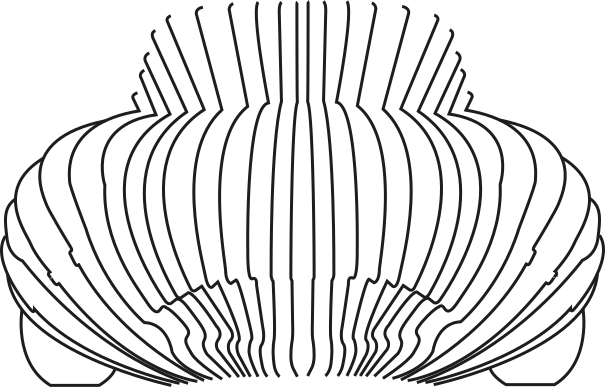
Stainless steel is Antoine Dufilho’s signature material. It comes in two main finishes with radically different effects. Mirror polish reflects light and the environment, creating reflections that constantly change according to the viewer’s point of view. It can be found on bases, wheels and certain fuselages. The Porsche 993 Solaire, for example, exploits this property so that the two sets of plates reflect each other.
Bead-blasted, on the other hand, produces a satin-finish surface that gently absorbs and diffuses light. In this finish, the sculpture appears to change color according to the ambient lighting. The Porsche 992 Streamline in bead-blasted raw metal finish produces a visual effect that evokes threads of air moving across the bodywork. These two treatments are sometimes combined within the same sculpture.
Aluminum, from fuselage to wheels
L’aluminium intervient à plusieurs niveaux dans les sculptures. Pour les pièces de collection, les roues sont réalisées en aluminium massif poli, un choix qui confère un éclat et un poids spécifiques à cette partie essentielle de chaque œuvre. Les fuselages utilisent des plaques d’aluminium martelées et soudées, parfois habillées de peinture laquée. Sur les monumentales, l’aluminium prend la forme de lames : la Red Racing Flower, Ferrari 330 P4 exposée de manière pérenne devant l’hôtel Westminster au Touquet, est constituée de 100 lames d’aluminium laquées en rouge.
Antoine Dufilho’s ability to work with aluminum in all its forms stems from his self-taught apprenticeship. From his first sculpture in 2011, a Bugatti Type 35 in solid aluminum, he experimented with casting and welding, gradually developing his trademark aesthetic.
From corten to carbon: exceptional materials
Some sculptures use less conventional materials. Corten steel, with its natural rusty patina, was chosen for the Riva Aquarama’s monumental sculpture, La Dolce Vita. Installed in Le Touquet since December 2024, this 7-metre, 5.5-tonne piece uses corten to visually replace the wood of the first Rivas, creating a striking contrast with the mirror-polished stainless steel.
As long ago as 2013, Antoine Dufilho integrated Macassar ebony into his Mercedes Streamliner to evoke anatomical musculature, a direct nod to his medical studies. More recently, the artist took a new step by integrating carbon into his Ferrari Enzo, adding a material derived from motor racing to his palette.
From collector’s items to monumental sculptures
Collection size: approx. 80 x 36 cm
Les sculptures dites de collection partagent des proportions cohérentes. Le format standard est d’environ 80 x 36 cm, avec une profondeur variant de 17 à 20 cm selon les modèles. La McLaren Speedtail bleue, légèrement plus longue, mesure 85 x 38 x 21 cm. Le poids oscille autour de 30 kg, la GT40 Gulf Blue étant documentée à 32 kg.
Each collector’s sculpture features a polished stainless steel base, polished solid aluminum wheels and an aluminum or steel fuselage, depending on the finish chosen. Available colors vary by model: red, black, blue, orange, green, gray, raw metal or the tricolor anodized finish of the Ferrari 250 GTO Tricolore. All models in the collection can be viewed on the galleries page.
Monumental scale: up to 7 meters and 5.5 tons
Monumental sculptures form the other side of Dufilho’s work. Their dimensions vary considerably. The Gunmetal Symphony (Porsche 911 in stainless steel tubes) measures 4.30 m x 1.80 m x 1.40 m. The Red Racing Flower is 4.60 m x 1.93 m and weighs 1.7 tonnes. Formula One measures 4.30 m x 2 m x 1 m and 1.2 tons. As for La Dolce Vita, it exceeds 7 meters in length for 5.5 tons.
These pieces are generally one-offs or very limited editions. Some are acquired by local authorities for permanent installation in public spaces, as in Le Touquet where two monumental works are now permanently installed.
Limited editions and manufacturing processes
8 copies + 4 artist’s proofs: the choice of rarity
Les sculptures de collection d’Antoine Dufilho sont produites en éditions limitées à 8 exemplaires, auxquels s’ajoutent 4 épreuves d’artiste. Ce format, vérifié sur l’ensemble des fiches techniques disponibles dans ses galeries partenaires, s’applique de manière constante à travers le catalogue : Ferrari 812 Superfast, Porsche 992 GT3 Touring, Aston Martin DB5, Alpine A110, Lamborghini Miura, McLaren Speedtail et toutes les autres références.
This choice of rarity positions each sculpture in a market segment consistent with limited edition contemporary art. It guarantees collectors genuine exclusivity, with each piece numbered and signed by the artist.
From 60 to 300 components machined to a tenth of a millimetre
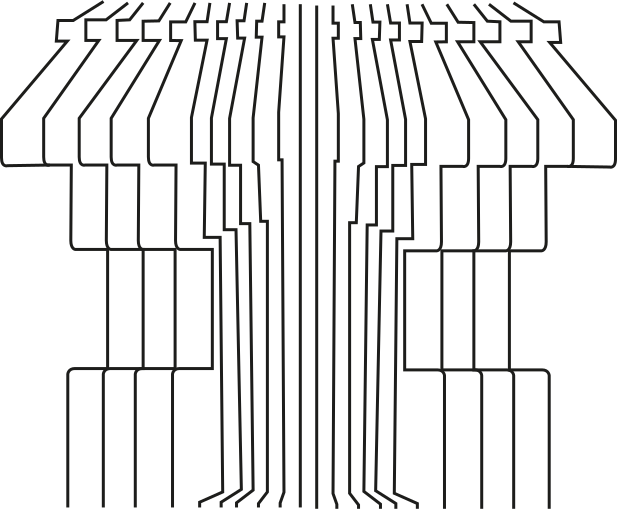
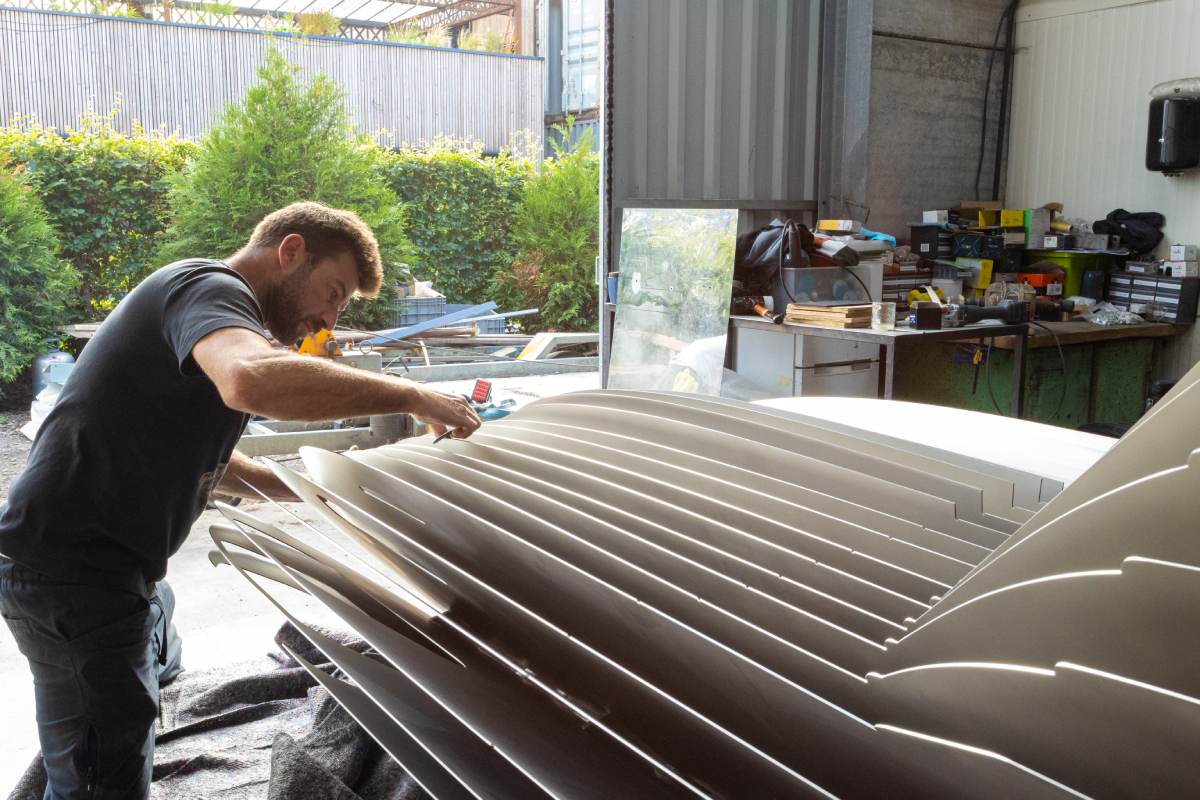
The manufacturing process for a Dufilho sculpture takes between 7 and 30 working days, depending on the complexity of the model. Each piece is made up of 60 to 300 individual components, machined to a tenth of a millimeter. This precision, inherited from his training as an architect at the École d’Architecture et de Paysage de Lille, explains the quality of assembly that characterizes his works.
The artist’s studio, built from scratch from shipping containers in the Lille countryside, is the unique place where all his sculptures are born. It’s here thatAntoine Dufilho experiments with his Streamline, Solaire and asymmetrical techniques, and develops the new approaches that have been driving his work since 2012. The Porsche 356 Asymétrique and the Ferrari 250 GTO Streamline are among the most accomplished examples of this research.