



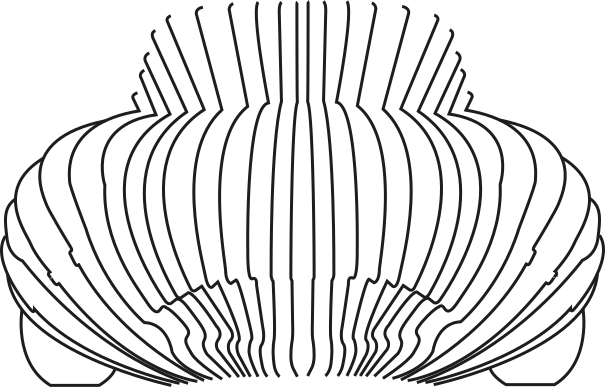
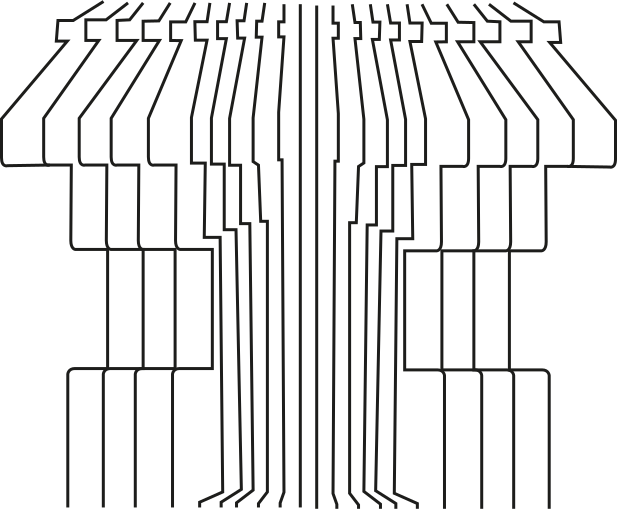
Ferrari 812 Superfast by Antoine Dufilho: total asymmetry at the service of movement
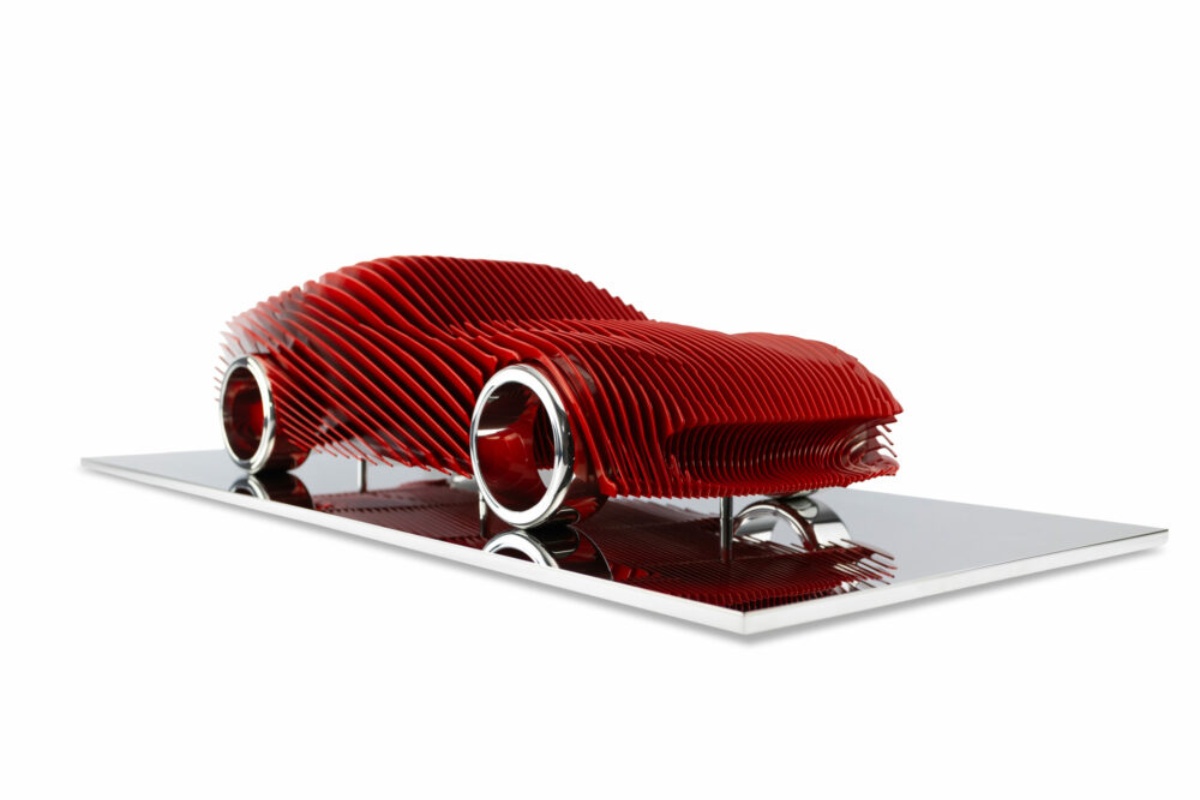
Among the Ferraris inAntoine Dufilho‘s catalog, the 812 Superfast occupies a singular place. Already present in a collection version at Galerie Marciano in a classic red livery, it is the subject of a radical reinterpretation: an entirely asymmetrical design that takes the artist’s kinetic concept to a whole new level. This choice is not insignificant. The 812 Superfast is the last production Ferrari with a naturally-aspirated V12 engine, a pivotal model in Maranello’s history. The total asymmetry Dufilho applies to it makes it an equally pivotal piece in the evolution of his own work.
A completely asymmetrical sculpture
The impression of movement through imbalance
Asymmetry is a principle that Antoine Dufilho has been exploring since 2023. The concept is based on a precise perceptual mechanism: our brain tends, by anticipation, to imagine the logical sequence of events, and when it perceives an asymmetrical object, it projects itself into the movement of this object, imagining it falling or rising. The artist has turned this cognitive property into an artistic tool.
With the Ferrari 812 Superfast, asymmetry no longer applies to certain areas of the sculpture, but to its entirety. Every plate, every angle, every spacing contributes to an overall impression of movement. The artist himself describes this piece as giving the sensation that the sculpture is in constant motion, whatever the angle of observation.
Three viewpoints, three different sculptures
One of the consequences of this total asymmetry is the multiplication of possible readings. From the front, in profile, three-quarter view, the sculpture offers fundamentally different silhouettes. This is not a new phenomenon in Dufilho’s work – all his sculptures play with the viewer’s point of view, as demonstrated by the Porsche 992 Sport Classic or theAston Martin DB5 – but total asymmetry radicalizes it. Fills and voids are no longer distributed according to a symmetrical logic, making each angle truly unique.
This characteristic ties in with the very essence of kinetic art, which the artist has been practicing since 2012: the sculpture is a static object that comes to life through the movement of its viewer. Total asymmetry amplifies this effect, making it unpredictable what the viewer will discover by changing position.
The genesis of Dufilho’s asymmetry
The Asymmetrical 356: the founding concept of 2023
It all began with the Porsche 356 Asymétrique. In 2017, Antoine Dufilho had already created this model with a classic longitudinal treatment. In 2023, he took it up again with an entirely new concept: asymmetrically arranged plates creating a kinetic illusion through visual imbalance. The 356 Asymétrique became a founding model, the first to exploit this perceptive mechanism in the artist’s work.
The technique was then developed on the Porsche 901, where the plates are very tight at the front of the car and gradually spread out towards the rear. This treatment gives the blades a new, knife-sharp shape, further accentuating the kinetic effect. Every step of the way has pushed the concept’s limits a notch further.
From the 901 to the 812: each model pushes the limits
The progression is clear: the 356 Asymétrique applies asymmetry as a concept, the 901 intensifies it by gradually varying the spacing, and the 812 Superfast takes it to its logical conclusion by applying it to the entire sculpture. It’s no longer a local treatment, but a global construction principle.
This progression can be seen as comparable to Dufilho’s Streamline approach: first explored on the 250 GTO in 2022, it was then applied to the E-Type, Murciélago, Speedtail, 992 and many other models, with each iteration enriching the technique. Asymmetry seems to follow the same path of progressive deepening.
The 812 Superfast: Ferrari’s last naturally-aspirated V12
800 horsepower, a legendary V12
The original Ferrari 812 Superfast is a milestone in the history of the Italian marque. Introduced in 2017, it features a 6.5-liter naturally-aspirated V12 developing 800 hp, making it the most powerful front-engined Ferrari ever produced at the time of its release. Its very name is a tribute: “812” is the result of the displacement/power ratio (6,496 cm³ / 800 hp = 8.12 cm³/hp). From 0 to 100 km/h in 2.9 seconds, with a top speed of 340 km/h.
But it’s above all its status as the last production Ferrari with a pure naturally-aspirated V12 engine that gives it particular historical significance. Replaced in 2024 by the Ferrari 12Cilindri, the 812 Superfast marks the end of a line that goes back to the brand’s very origins in 1947. This “last in a line” status resonates with Antoine Dufilho’s choice to make it the first sculpture in total asymmetry.
A model made for sculpture
The design of the 812 Superfast lends itself particularly well to sculptural interpretation. Its three-dimensional sides, side air intakes and fastback profile create complex volumes that Dufilho’s asymmetry can exploit to the full. The taut lines of the original car, inherited from the 365 GTB4 Daytona of 1969, provide a strong visual base that the decomposition into asymmetrical plates energizes.
The collector’s version of the red 812 Superfast is available from Galerie Marciano in aluminum and stainless steel, 80 x 36 x 20 cm, in an edition of 8. The asymmetrical version is an evolution of this interpretation, taking the same model into an entirely different expressive register. It joins Dufilho’s corpus of Ferraris, which includes the 250 GTO Streamline, the Dino 246, the Daytona SP3 and the F40. All the creations can be seen in partner galleries.
And also