



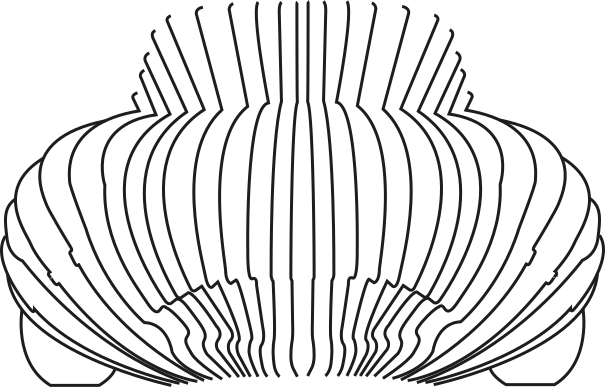
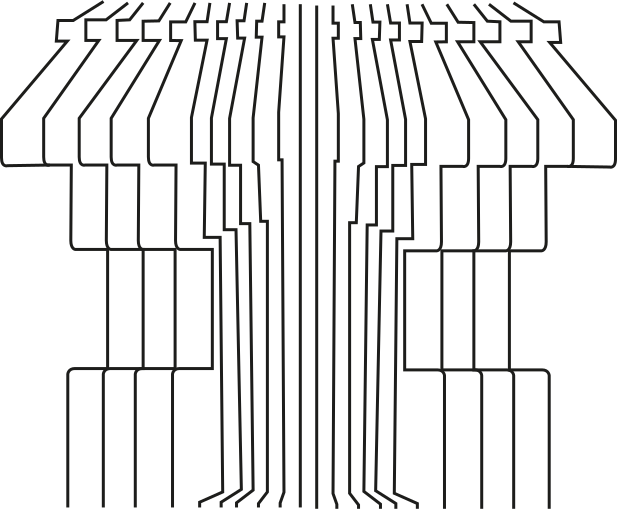
These legendary cars sculpted by Antoine Dufilho
Automotive Sculpture: The Movie Cars That Antoine Dufilho Brings Back to Life
Since 2012, Antoine Dufilho has been building a collection of models, ranging from pre-war Bugattis to today’s hypercars. Many of these cars share a common trait: they have made their mark on the big screen just as much as on the road. And that’s no coincidence. Each sculpture seeks to freeze movement, to capture speed in a suspended moment. Ultimately, a camera filming a car chase does the same thing. The difference is that film captures the moment in time, while sculpture captures it in space.
The Mustang: A Sculpture Built for the Race Track
In the artist’s body of work, the Ford Mustang embodies the quintessential muscle car. With its compact silhouette, broad shoulders, and a presence that stems as much from its mechanics as from its attitude, it is this raw energy that a certain cinematic image has etched into our memories.
It’s impossible to mention the Mustang without thinking of *Bullitt* (1968) and its car chase through San Francisco. Behind the wheel, Steve McQueen drove a dark green Mustang at full speed. But Dufilho isn’t retelling the movie. He captures the stance and tension of a car built for the asphalt. His sculpture doesn’t replicate the car from the screen. It captures its spirit—that blend of power and edginess that has become iconic thanks to the film.
The Aston Martin DB5: British elegance in metal form
It’s a complete change of pace with the Aston Martin DB5, which the artist has sculpted in a blue finish. Here, there’s no more brute force. Long curves, a distinctly British restraint, and the refinement of a 1960s grand tourer. The DB5 commands respect without raising its voice.
That is precisely what made it, starting with *Goldfinger* (1964), the most famous James Bond car in cinema history. It subsequently reappeared in seven other films in the series. This sleek silhouette, with its flowing lines, offers an ideal canvas for kinetic sculpture. By breaking it down into slats, Dufilho reveals the design hidden beneath its elegance. He unveils the rhythm of a body that the eye thought it already knew.
The Ford GT40: The Spirit of Endurance
With the Ford GT40, we enter the realm of pure racing. Its name comes from its height of forty inches. Designed to devour the straights at Le Mans, it remains the archetype of the endurance prototype. In the artist’s interpretation, its low, ground-hugging silhouette becomes a pure exercise in frozen speed. Viewers then piece the car back together as they walk around it.
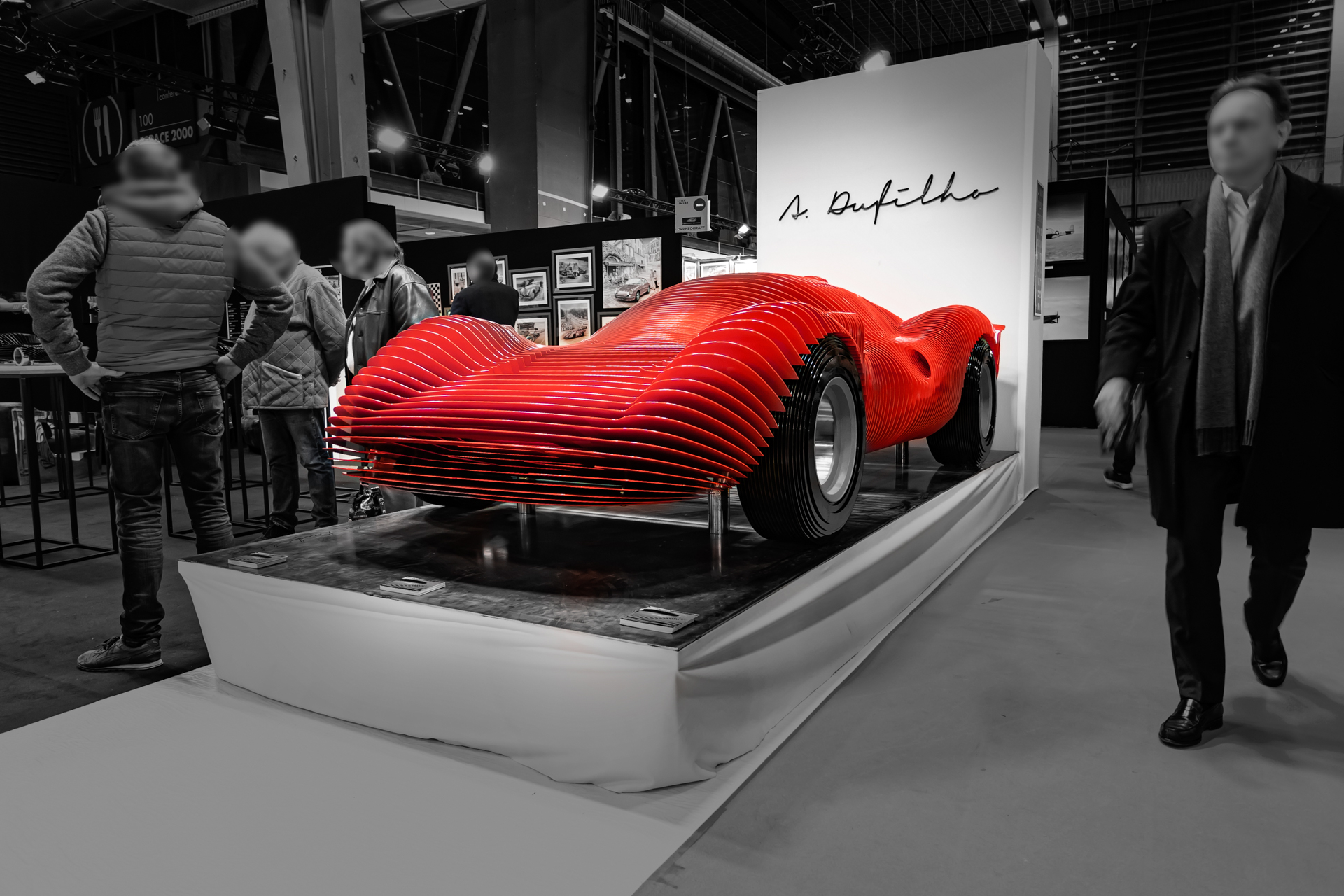
The GT40 is also part of one of the greatest stories in motorsports, made famous by Le Mans ’66. In that epic showdown, Ford dethroned Ferrari at the 1966 24 Hours of Le Mans. Opposite it, Dufilho has also sculpted the Ferrari from the 330 P series. His monumental sculpture, *Red Racing Flower*, inspired by the 330 P4, displays its red fins in front of the Westminster Hotel in Le Touquet. Two legendary rivals, united in a shared language of metal.
From the Tarmac to the Sky: Rafale and Concorde
The artist’s world extends beyond the automobile. In recent years, he has turned his attention to the skies. His sculptures now feature legendary aircraft, from the Dassault Rafale to the Concorde. The same fascination is evident here. It is always a matter of breaking down a machine designed for speed in order to reveal its momentum and trajectory.
Once again, cinema is never far away. The world of aviation films, popularized by *Top Gun*, has instilled in us the thrill of flight. Antoine Dufilho draws on this world without copying it. His airplanes aren’t taken from any specific movie. They simply extend his quest for movement, from automobiles to aeronautics.
Sculpture, or the Machine Transformed into Emotion
Whether it’s a Mustang, an Aston Martin, a GT40, or a fighter jet, the thread remains the same. These machines have left their mark on cinema because they evoke an immediate emotion, even before any analysis takes place. It is this emotional spark that every sculpture by Antoine Dufilho seeks to evoke. The viewer first approaches the work through passion or memory. Then, as they walk around it, they discover the interplay of form, space, and light.
Movies have turned these cars into legends. Sculpture, on the other hand, elevates them to the realm of art. These machines had, in fact, made their mark on history long before the advent of cinema, as the Ford Mustang entry reminds us. To explore the full range of models, visit the monumental sculptures page and check out the artist’s latest news.